
%5D(https://baumlinks.com/about-me/)
LEGO® dropped one of the most polarizing sets of 2025 with the Icons Tropical Aquarium (10366) — a massive, 4,154-piece brick-built fish tank that retails for $479.99. That’s not a typo. Four hundred and eighty dollars for an unlicensed display set with zero minifigures.
I’ve been going back and forth on this one since it was announced in October, and after digging through every review, community thread, and price comparison I could find, I have thoughts. A lot of them.
What You’re Actually Getting
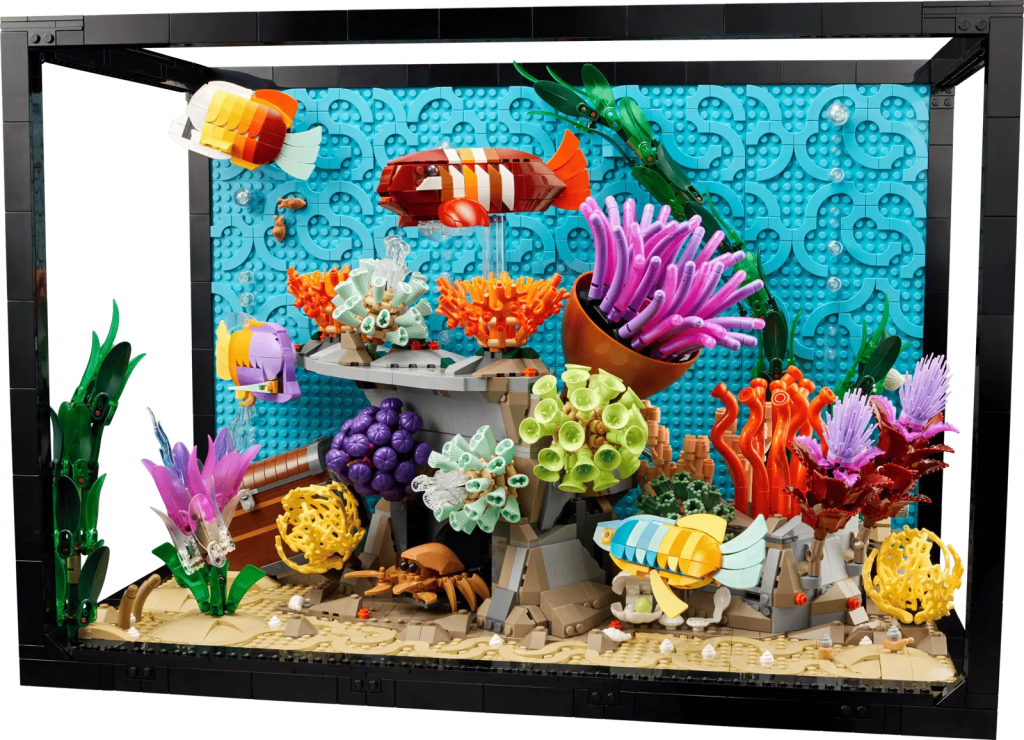
The Tropical Aquarium is a life-sized brick-built fish tank that measures about 20.5 inches wide, 14 inches tall, and 11 inches deep. It’s big. Like, takes-over-your-entire-desk big. The box alone is a monster.
Inside, you’re building a full underwater scene: coral formations, rock caves, plant life, and four tropical fish — two angelfish, a rainbow fish, and something LEGO invented called a “striped brickfish.” None of the fish are based on actual species, which is a weird choice for a set clearly aimed at aquarium hobbyists. A clownfish or a tang would have been an easy win, but LEGO went with their own creative interpretations instead.
The big selling point beyond the display factor is that this thing actually moves. There are hidden cranks and dials throughout the build that let you animate the fish, sway the coral, pop a crab out of a cave, and open a treasure chest. It’s not motorized — everything is manual — but the mechanical engineering underneath is genuinely impressive.
LEGO also designed a brand new fin element specifically for this set. The element designer, Matéo Dupureur, built it so it can tessellate — use one or two for small fish, stack four for the bigger ones. That piece alone has serious MOC potential down the road.
The Build Experience: Patience Is Required
Here’s the thing nobody tells you upfront: you won’t touch a single fish or piece of coral until you’re about two-thirds through the 500-page instruction manual. The first several hours are spent building the black frame, the sandy base, and an azure backdrop that involves placing over 160 curved tiles. One entire bag is nothing but two types of blue tiles. That’s it. That’s the bag.
Every single reviewer I’ve read flagged this as the biggest weakness. The structural foundation work is necessary, but it’s tedious. If you’re the kind of builder who needs visual progress to stay motivated, the first half of this build is going to test you.
But once you hit the coral section, the set completely transforms. This is where LEGO’s designers went all out. They used minifigure headwear — chef’s hats, pith helmets, crowns, mop heads, even broom ends — to create organic coral textures. There’s an Iron Man helmet recolored and repurposed as a crab shell. The techniques are wild and genuinely fun to discover as you build.
The whole structure also uses some clever off-grid engineering. There are Pythagorean triple placements (3-4-5 ratios) throughout, which is how they got those natural-looking angles that don’t feel “bricky.” Mixel joints and towball connections position the treasure chest at a realistic tilt in the sand. It’s a masterclass in advanced building techniques if you pay attention.
The Price Problem (In This Economy?!)
Let’s talk about the elephant in the room: $479.99 for a set with no license fees, no minifigures, and no printed pieces. At roughly 11.5 cents per piece, this is expensive by any measure.
For context, the LEGO® Rivendell set has over 6,000 pieces, 15 minifigures, and a Lord of the Rings license — for the same price. The comparison isn’t flattering.
The community reaction has been overwhelmingly focused on this. The Brickset comment section turned into a full debate, with most fans landing somewhere between “this should be $300” and “LEGO has lost the plot.” A few people pointed out that the black tank frame eats up hundreds of pieces that add nothing to the visual appeal — ditch the frame, make it a diorama, and the price drops significantly.
On the other side of the argument, there’s a case to be made if you’re coming at this from the fishkeeping world. A real marine aquarium setup — tank, sump, protein skimmer, lights, live rock — can easily run $500 before you’ve added a single fish. And then there’s the ongoing maintenance. The LEGO version gives you the aesthetic without the water changes, the dead fish, and the monthly expense.
That’s the audience LEGO is betting on: people who want an aquarium on their shelf without the commitment. Whether that audience is big enough to justify this price point is the real question.
The GWP That Should Have Been Included
If you bought the set during the first week (November 13-19), you received the Fish Tank Filter & Fish Food (5009823) as a free Gift with Purchase. It’s a small add-on — a filter unit that sits on the outside of the tank with an intake tube and a stray fish stuck inside.
Here’s why this rubbed people the wrong way: a filter is a fundamental part of an aquarium. Including it as a limited-time bonus instead of part of the base set — at $480 — felt like LEGO was nickel-and-diming their most dedicated customers. The community noticed, and they weren’t happy about it.
If you missed the GWP window, you’re not losing anything critical to the display, but it’s the principle that stings.
Who This Set Is Actually For
This isn’t for everyone, and LEGO knows that. The Tropical Aquarium sits in a strange middle ground:
It’s too expensive for casual LEGO fans who just want a fun weekend build. The price-per-piece ratio doesn’t hold up against almost any other Icons set.
It’s too “creative interpretation” for serious aquarium hobbyists who would have preferred real fish species and a more realistic color palette. Some commenters thought the colors were garish. Others loved the vibrancy.
Where it does work is as a genuine display piece for someone who wants a conversation starter in their living room or office. The thing commands attention. The colors pop, the mechanical features give it life, and at 20+ inches wide, it fills a space in a way that most LEGO sets don’t. It falls in a similar category to the Bird of Paradise — another unlicensed display set that commands a premium.
I’d also argue it’s a sleeper pick for parts collectors. The sheer number of rare recolored elements — in good quantities — makes this set interesting on BrickLink. Once people start parting these out, the aftermarket for individual coral pieces and the new fin elements could be significant.
Should You Buy It Now or Wait?
This is the real question for most people reading this. Here’s my take:
If you’re in love with it and the price doesn’t make you flinch, buy it. The build experience from the coral section onward is genuinely excellent, and the finished display is stunning. You’ll also have the GWP window closed already, so there’s no urgency on that front.
If you’re on the fence, wait. Multiple community members predicted this set will hit 30-40% discounts within a year. LEGO has a pattern with expensive, niche, unlicensed sets — they don’t always move at full retail. The BrickNerd review compared it to the Little Mermaid Clamshell set, another pricey aquatic display piece that eventually saw deep discounts. When the time comes, knowing where to find the best price will save you even more.
For collectors thinking about long-term value: the predecessor to this set, the Creator 3-in-1 Fish Tank (31122), is retired and carries a premium now. Whether this much larger, much more expensive set follows the same path depends entirely on production run length and how quickly LEGO retires it. I’d keep an eye on retirement rumors before pulling the trigger as an investment piece.
May 2026 Update: Six Months In, The Market Has Spoken
It has been about six months since launch and the Tropical Aquarium is still very much available at LEGO.com and most major retailers. The dreaded “30-40% discount” prediction has not fully materialized yet — Amazon and Walmart have run sporadic 10-15% markdowns during the spring sale windows, but nowhere near the markdown some people expected. That actually says something about how this set has performed: it has carved out a real audience of display collectors and aquarium-adjacent hobbyists who are paying retail without much grumbling.
The early BrickLink parting-out theory has also started playing out. The new fin element designed for this set is already showing up in MOC builds across Reddit and Rebrickable, and the rare-color coral pieces have become quietly hot on BrickLink. If LEGO retires this set in 2027 or 2028, expect the parts market to do most of the post-retirement heavy lifting before sealed prices start moving. That mirrors the path the Bird of Paradise took before its own value pop.
Bottom line for May 2026: still expensive, still polarizing, still beautiful. If you waited and are now hoping for a deep discount, the patience play has not paid off as much as some fans predicted. If you bought one at launch and built it, you are sitting on one of the most distinctive display sets LEGO has made in years.
Beautiful But…A Bit Too Expensive
The LEGO® Tropical Aquarium is a beautiful, technically impressive display set that’s held back by a price tag most people can’t justify. The coral building techniques are some of the best LEGO has put out in years, the mechanical features add genuine charm, and the finished model looks incredible on a shelf.
But at $480 with no minifigures, no license, and a build that drags for the first several hours, it’s a tough sell at full retail. LEGO is betting that aquarium enthusiasts and display collectors will pay the premium. For everyone else, patience will probably pay off.
Frequently Asked Questions About The LEGO® Tropical Aquarium
How much does the LEGO® Tropical Aquarium cost?
The Tropical Aquarium (10366) retails for $479.99 in the US (£399.99 / €449.99). That works out to about 11.6 cents per piece across the 4,154-piece build — pricey for an unlicensed Icons set with no minifigures.
How many pieces are in the LEGO® Tropical Aquarium?
4,154 pieces. It measures roughly 20.5 inches wide, 14 inches tall, and 11 inches deep — easily one of the largest display Icons sets in the lineup.
Is the LEGO® Tropical Aquarium retired?
No. As of May 2026, the set is still available at LEGO.com and most major retailers. No retirement date has been announced yet.
Are the fish in the aquarium real species?
No — LEGO designed four custom fish for the set: two angelfish-style builds, a rainbow fish, and an invented “striped brickfish.” A real clownfish or tang would have made more sense for aquarium fans, but the creative direction went original.
Is the LEGO® Tropical Aquarium a good investment?
Too early to call definitively, but the parts market is already heating up on BrickLink — the new custom fin element and recolored coral pieces are showing real demand. Long-term, the post-retirement value will depend on how long LEGO produces it. The predecessor Creator 3-in-1 Fish Tank (31122) appreciated nicely after retirement, which is a positive signal.

Matt Buxbaum · CEO at Baumlinks LLC
Matt B. spends his time arm wrestling, boxing, and most importantly, building LEGO®. His eclectic tastes give you dynamic information on all things LEGO® news and LEGO® product releases.
Latest from Matt: Why Is LEGO® So Expensive? We Ran The Numbers On 6,087 Sets · The Best LEGO® Minifigure Display Cases And Storage (2026) · The Best LEGO® Display Cases In 2026 (With Real Weight Data)