
Somewhere in your house right now there is a LEGO® set you spent three weekends building, and it is collecting dust in the most literal sense available. I know because mine was the Grand Piano, and it sat on an open bookshelf for eight months absorbing everything my HVAC system threw at it. Cleaning dust out of 3,662 pieces is not a hobby. It is a punishment. A display case would have cost me $40 and saved me an afternoon with a makeup brush.
So this guide is the one I wish I’d read first. I’ve pulled live demand data from our set database to show you what collectors are actually putting behind acrylic in 2026, weighed the options (literally, there’s a weight table, and it matters more than you think), and matched real products to real builds.
The short answer
If you want one recommendation and a fast exit: get a large clear acrylic enclosure for your centerpiece set, a model-specific case for anything helmet-sized, and skip glass shelving entirely unless you’ve checked the weight rating. The full reasoning, the data, and the specific products are below.
The sets collectors actually display in 2026
Our database tracks a Heat Index for every current LEGO® set, a percentile score built from how many collectors own a set versus how many want it. Before you buy a case, it’s worth seeing what everyone else is protecting, because the sets people display are the sets people case. Here are the ten hottest display pieces in production right now:
| Set | Theme | Pieces | US MSRP | Heat Index |
|---|---|---|---|---|
| Millennium Falcon (75192) | Star Wars | 7,541 | $849.99 | 99.7 |
| Rivendell (10316) | Icons | 6,167 | $499.99 | 99.4 |
| Venator-Class Attack Cruiser (75367) | Star Wars | 5,374 | $649.99 | 99.1 |
| Titanic (10294) | Icons | 9,090 | $679.99 | 99.0 |
| Natural History Museum (10326) | Icons | 4,014 | $299.99 | 98.8 |
| Hogwarts Castle (71043) | Harry Potter | 6,020 | $469.99 | 98.7 |
| Jack Sparrow’s Pirate Ship (10365) | Icons | 2,862 | $379.99 | 98.4 |
| Shopping Street (11371) | Icons | 3,456 | $249.99 | 98.4 |
| The Botanical Garden (21353) | Ideas | 3,792 | $329.99 | 98.4 |
| Barad-dûr (10333) | Icons | 5,471 | $459.99 | 98.3 |
Data: Baumlinks Brick Data, August 31, 2026. Heat Index is our demand percentile across all rankable current sets.
Nine of the ten are display-first sets. Nobody swooshes a 9,090-piece Titanic around the living room. You build it once, you park it somewhere visible, and then the set spends years fighting dust, sunlight, and the ambient chaos of your household. That fight is what the rest of this article is about.
Full enclosures, model cases, and shelves
Everything on the market falls into three buckets, and picking the right bucket matters more than picking the right brand.
Full acrylic enclosures
A five-sided clear box that drops over the finished build, usually with a separate base plate. This is the gold standard for anything you genuinely care about: total dust protection, no fingerprints from curious guests, and the set still reads as furniture-grade decor. The catch is sizing (more on that below) and the fact that big acrylic gets expensive fast. For a mid-size centerpiece like the Botanical Garden or Jack Sparrow’s ship, a large collectibles case is the sweet spot.

Model-specific cases
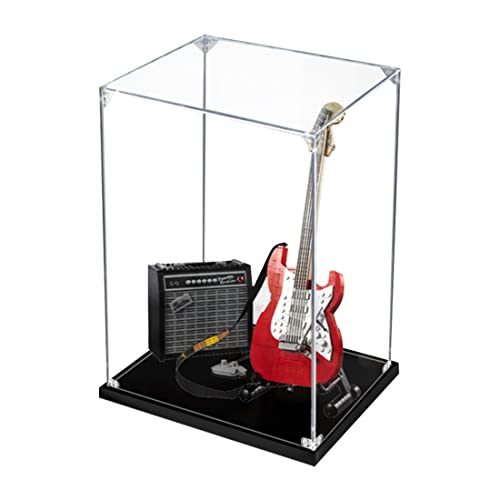
Several third-party makers now cut acrylic to fit one exact set, with the set number in the product listing. If your display piece happens to be one of these, buy the tailored version every time. The fit is cleaner, the footprint is smaller, and you skip the measuring homework entirely. The Fender Stratocaster case below is a good example of the breed, and similar tailored cases exist for helmets, the Typewriter, and most of the big Icons sets.
Shelves and wall mounting
Open shelving looks fantastic and protects against exactly nothing. I still use it, but only for sets I’m willing to dust and only after checking the one number most people skip: the weight rating. A clear acrylic floating shelf is the best-looking version of this option, and it keeps the focus on the build rather than the furniture.

If you’re going the wall route with LEGO® art specifically (the Hokusai, Starry Night, the mosaics), I wrote a full guide on how to hang LEGO® art safely that covers anchors, adhesives, and which frames actually hold.
The weight problem nobody checks
Here is the section that justifies this article’s existence. I ran our database for the heaviest sets currently in production, using boxed shipping weights. The built model weighs a little less than the box, which makes these numbers a comfortable safety ceiling:
| Set | Pieces | Boxed weight | US MSRP |
|---|---|---|---|
| Grand Piano (21323) | 3,662 | 6.1 kg / 13.4 lb | $399.99 |
| Natural History Museum (10326) | 4,014 | 5.1 kg / 11.3 lb | $299.99 |
| The Botanical Garden (21353) | 3,792 | 4.2 kg / 9.3 lb | $329.99 |
| Italian Riviera (21359) | 3,251 | 3.9 kg / 8.6 lb | $299.99 |
| Shopping Street (11371) | 3,456 | 3.9 kg / 8.6 lb | $249.99 |
| Explorer Train (60470) | 1,517 | 3.8 kg / 8.4 lb | $209.99 |
| Tudor Corner (10350) | 3,266 | 3.6 kg / 7.8 lb | $229.99 |
| The City Tower (60473) | 1,941 | 3.4 kg / 7.5 lb | $209.99 |
| The Great Wave (31208) | 1,810 | 3.0 kg / 6.5 lb | $99.99 |
| Starry Night (21333) | 2,316 | 2.9 kg / 6.3 lb | $169.99 |
Data: Baumlinks Brick Data, August 31, 2026. Twenty-four current sets exceed 2 kg boxed.
Why this matters: a lot of decorative floating shelves, especially the peel-and-stick and single-bracket kind, are rated for 2 to 5 kg, and the rating assumes the load sits centered against the wall. A Grand Piano parked at the front edge of a marginal shelf is a lever, and drywall anchors lose that argument. Before any set over 2 kg goes on a wall, check the printed rating on the shelf packaging, use the anchors the shelf shipped with (into a stud if you can find one), and keep heavy builds pushed back against the wall. Our heaviest LEGO® sets ranking has the full weight list if your set isn’t in the table above.
Sizing: the box lies
The most common display-case mistake is ordering acrylic based on the dimensions printed on the LEGO® box, or worse, the box itself. Box dimensions describe cardboard, and the relationship between cardboard and finished model is basically random. The UCS Millennium Falcon ships in a box about 53 cm wide and builds out to roughly 84 cm long. The Titanic box is 58 cm wide; the built ship is 135 cm long. Order a case from box dimensions and you will be starting a return.
The rule: build first, then measure the model itself at its widest points, then add at least 2-3 cm of clearance per side so the case never touches the build. Antennas, masts, and wings snap. Acrylic doesn’t apologize.
Dust, sunlight, and the yellowing problem
Dust is annoying but reversible. Sunlight is neither. Prolonged direct sun fades and yellows bricks, and white and light-gray pieces show it worst, which is why so many vintage Star Wars sets on the secondhand market look like they were dipped in weak tea. An acrylic case does nothing against UV unless it’s specifically UV-filtering acrylic, so the real fix costs nothing: keep display sets out of direct window light. If the spot you love gets afternoon sun, that’s the spot for your darkest set, and your Stormtroopers live somewhere else.
Picks by budget
Under $30: a tailored small-set or helmet case. The helmet line (Vader, the Mandalorian, the Stormtrooper) was designed to be displayed and deserves better than open air.

$30 to $75: this is where the large general-purpose enclosures and the model-specific mid-size cases live, like the Razor Crest stand below or the Typewriter case. One well-chosen case here protects a $200-400 set, which is the best insurance math in the hobby.


*%5D(https://www.amazon.com/dp/B09PV9TDMZ?tag=baumlinks2626-20&linkCode=ogi&th=1&psc=1&ascsubtag=p11989-s1)
*%5D(https://www.amazon.com/dp/B0B58ZKS3Y?tag=baumlinks2626-20&linkCode=ogi&th=1&psc=1&ascsubtag=p11989-s2)
*%5D(https://www.amazon.com/dp/B095NR5XH5?tag=baumlinks2626-20&linkCode=ogi&th=1&psc=1&ascsubtag=p11989-s3)
*%5D(https://www.amazon.com/dp/B0BGSP7H7R?tag=baumlinks2626-20&linkCode=ogi&th=1&psc=1&ascsubtag=p11989-s4)
*%5D(https://www.amazon.com/dp/B0C536HR1K?tag=baumlinks2626-20&linkCode=ogi&th=1&psc=1&ascsubtag=p11989-s5)
*%5D(https://www.amazon.com/dp/B09Z2H2NTG?tag=baumlinks2626-20&linkCode=ogi&th=1&psc=1&ascsubtag=p11989-s6)
%5D(https://baumlinks.com/about-me/)
$75 and up: custom-cut acrylic for the flagships. If you own the Falcon, the Titanic, or Barad-dûr, you’re commissioning a case sized to your measurements (see the sizing rule above) rather than buying off the shelf. At this tier, also think about what happens when the set retires: several of the flagships in the heat table are climbing our retirement tracker, and a cased, dust-free copy is worth real money to the next owner in a way a shelf-worn copy never is.
Display case FAQ
Do display cases prevent yellowing?
Standard acrylic blocks dust, fingers, and pets, and it does filter some UV, but it is not sunscreen. Placement does more than acrylic here: keep cases out of direct sunlight and yellowing stops being your problem.
Should I glue a display set before casing it?
Please don’t. A cased set doesn’t face the bumps that break builds, and gluing destroys resale value along with the option to ever rebuild. I covered the (rare) exceptions in my LEGO® glue guide.
Case or cabinet for multiple sets?
Individual cases beat a shared cabinet once sets differ a lot in size, since one tall set forces every shelf tall. A glass-door cabinet (the IKEA route many collectors take) wins on cost per set displayed, loses on dust sealing, and ties with everything else on the weight rule: check the shelf rating before the Grand Piano goes in.
Whatever you pick, pick it before the dust does. My piano and I speak from experience.

Matt Buxbaum · CEO at Baumlinks LLC
Matt B. spends his time arm wrestling, boxing, and most importantly, building LEGO®. His eclectic tastes give you dynamic information on all things LEGO® news and LEGO® product releases.
Latest from Matt: Why Is LEGO® So Expensive? We Ran The Numbers On 6,087 Sets · The Best LEGO® Minifigure Display Cases And Storage (2026) · What Are LEGO® VIP Points Worth? (2026 Calculator + Conversion Table)